Most appointments that fall apart don't fall apart on the day. They fall apart a week earlier, when nobody said out loud what needed to be in the room.
Notary appointments are a clean example. The visit itself is usually short — you identify yourself, you sign, the notary signs and stamps. What turns that into two visits is almost always something mundane: the document was already signed, the ID was expired, a co-signer stayed home, or someone brought a photocopy when an original was needed. None of that is complicated. It just has to be sorted before you arrive.
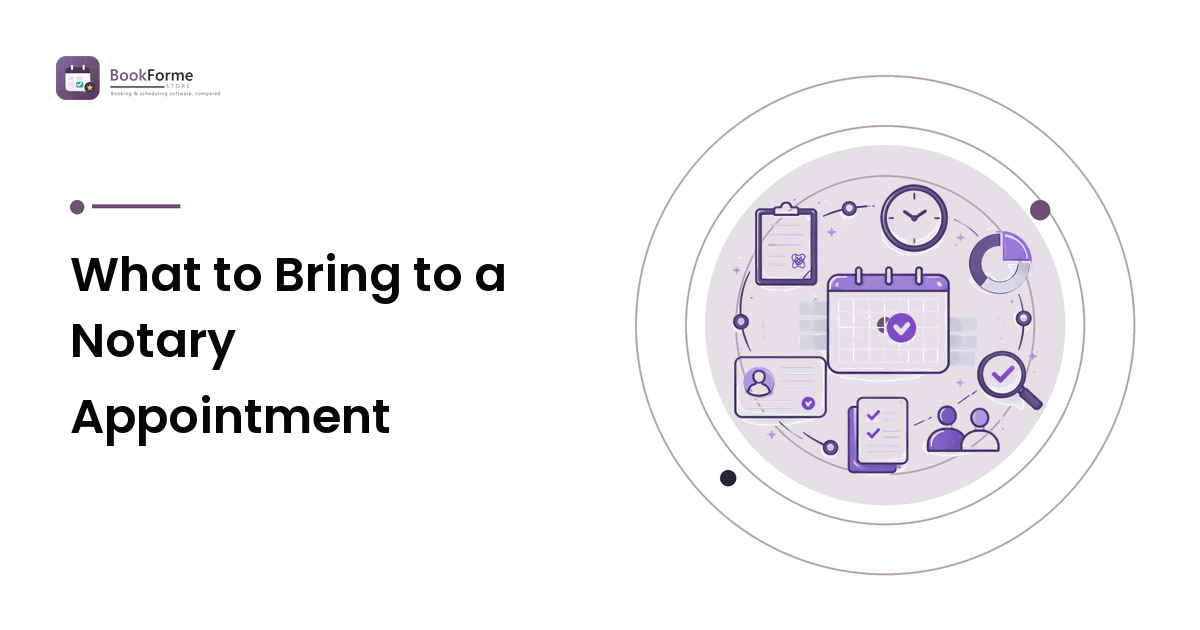
Here is the short version. Bring the complete, unsigned original document, valid government-issued photo identification, and everyone whose signature the document needs. The rest of this guide explains why each of those matters, what varies, and which questions to ask at the time of booking so the answer is settled before you're sitting across the desk.
First: know what your document actually needs
"Getting something notarized" covers several different jobs, and they don't need the same preparation.
- Swearing or affirming a statement — an affidavit or statutory declaration, where you're attesting that what the document says is true.
- Having a signature witnessed — the notary confirms who you are and watches you sign.
- Getting a certified true copy — a copy is compared against your original and certified as a true copy of it.
The Government of Saskatchewan's own description of the role is a useful reference point: a notary public administers oaths and takes and receives affidavits, affirmations and declarations, and is frequently asked to make a notarial copy of a document for official purposes. Saskatchewan also appoints commissioners for oaths, whose role is to administer and receive oaths, affirmations and declarations for documents in Saskatchewan — while a notary public may notarize documents intended for use both inside and outside the province. If your paperwork is heading to another province or another country, that distinction is worth raising when you book.
Providers who do this work daily will tell you which of the three you're actually asking for. In Saskatoon, for example, Evergreen Notary Saskatoon publishes its notarial services and appointment guidance on its own site, covering affidavits and statutory declarations, certified true copies and proof of identity, marriage licence issuance, and support for documents destined for use abroad. Reading a provider's own service page before booking is the fastest way to find out whether your document is a five-minute job or a longer one.
The checklist
1. The document — complete, and usually unsigned
Bring the whole document, not the signature page. Fill in every field you're responsible for before you arrive; blanks are what trigger corrections, and corrections are what turn a short appointment into a long one.
The part people get wrong most often: don't sign it in advance. Where a notary is witnessing your signature, they generally need to see you sign it. Evergreen Notary's published guidance puts the same rule plainly — clients are asked to sign in the notary's presence in order for the signature to be notarized. If you've already signed, expect to be asked to do it again on a fresh copy.
If the document was prepared for you by a lawyer, an employer, an embassy or a lender, bring their instructions too. They often specify wording, the number of witnesses, or a form that must be used.
2. Valid government-issued photo identification
Identity verification is the whole point of the exercise, so the ID has to be real, current, and physically in your hand — a photo of your licence on your phone is not the same thing. Evergreen Notary, again in its own published appointment guidance, asks clients to bring a physical, valid photo ID.
Requirements are not uniform. Some documents and some receiving institutions ask for two pieces of identification rather than one. Saskatchewan's marriage licence process is a published example: the province requires two pieces of government-issued identification, one of which must be photo ID. Because the standard depends on the document and on whoever will receive it, ask your provider what they need for your paperwork rather than assuming, and confirm current requirements with the authority the document is going to.
3. Everyone who has to sign
If a document needs two signatures, it needs two people at the appointment. Co-owners, both spouses, business partners, a second parent on a child's travel consent letter — anyone signing in front of the notary has to attend and bring their own ID.
Some documents also call for an independent witness in addition to the notary. That's a service many providers can arrange, but only if they know in advance. It's a booking question, not a doorstep question.
4. Supporting paperwork
Depending on the document, you may also need:
- The original of anything being copied and certified — originals, not photocopies or scans.
- Any form the receiving body issues. Canadian passport applications, for instance, use forms obtained from Service Canada before the appointment.
- Proof of the underlying facts the document refers to: certificates, titles, contracts, correspondence.
Book it like an appointment you only want to attend once
This is where a bit of booking discipline pays off, and it's the same discipline that keeps any service calendar healthy — the principles are in our appointment management guide.
Say what the document is when you book. "An affidavit" and "a certified copy of a birth certificate" are different appointments with different lengths and different requirements. A provider who knows which one is coming can tell you what to bring.
Ask three questions up front: what ID do you need from me, does anyone else have to attend, and do you need the original? Three answers, one message, no second visit.
Bundle your documents. If you have four things to notarize, do them in one appointment rather than four. Say so when booking, because it changes how much time gets set aside.
Check where and when it can happen. Many providers offer mobile or after-hours service — Evergreen Notary, for instance, publishes evening, weekend and mobile options alongside its office appointments. If a hospital, a care home or a workplace is the only realistic venue, that changes what you book, not whether you can book it.
Confirm, and confirm again. Missed appointments are mostly a reminder problem rather than a motivation problem, which is the argument we make in how to reduce no-shows. Put it in your own calendar with a note listing what you're bringing.
Frequently asked questions
What identification do I need? Valid, current, government-issued photo identification, in physical form. Some documents and some receiving institutions require a second piece. Ask your provider what applies to your document, and confirm current requirements with whoever will receive it.
Can I sign the document before I get there? Usually not. Where the notary is witnessing your signature, they generally need to watch you sign. Bring it complete but unsigned unless you've been told otherwise.
Is a photocopy or a scan good enough? Not for a certified true copy. That process compares a copy against your original, so the original has to be there. Many providers make the copy for you at the appointment.
Do I need a lawyer instead? Notarization confirms identity and signing — it is not legal advice, and this article isn't either. If you need to understand what a document means, what signing commits you to, or whether it's the right document at all, speak to a lawyer before the appointment.
What if the document is going to another country? It may need authentication after notarization. Saskatchewan's Authentication Services issues apostille certificates for documents issued or notarized in the province. Requirements and processing times are set by the issuing authority and the destination country, so check both before you plan around a date, and ask your notary whether they handle the submission.
Before you book
Preparation is the entire game here. The document, the ID, the people, and one message to the provider confirming all three — that's a single appointment instead of two.
If you're in Saskatoon or elsewhere in Saskatchewan and you have a document waiting, Evergreen Notary Saskatoon lists its notarial services, appointment options and booking details on its own site. Tell them what the document is when you book, ask what you need to bring, and turn up once.
This article is general information about preparing for an appointment. It is not legal advice, and no article can promise that a particular document will be accepted by a particular institution — always confirm current requirements with the authority receiving it.