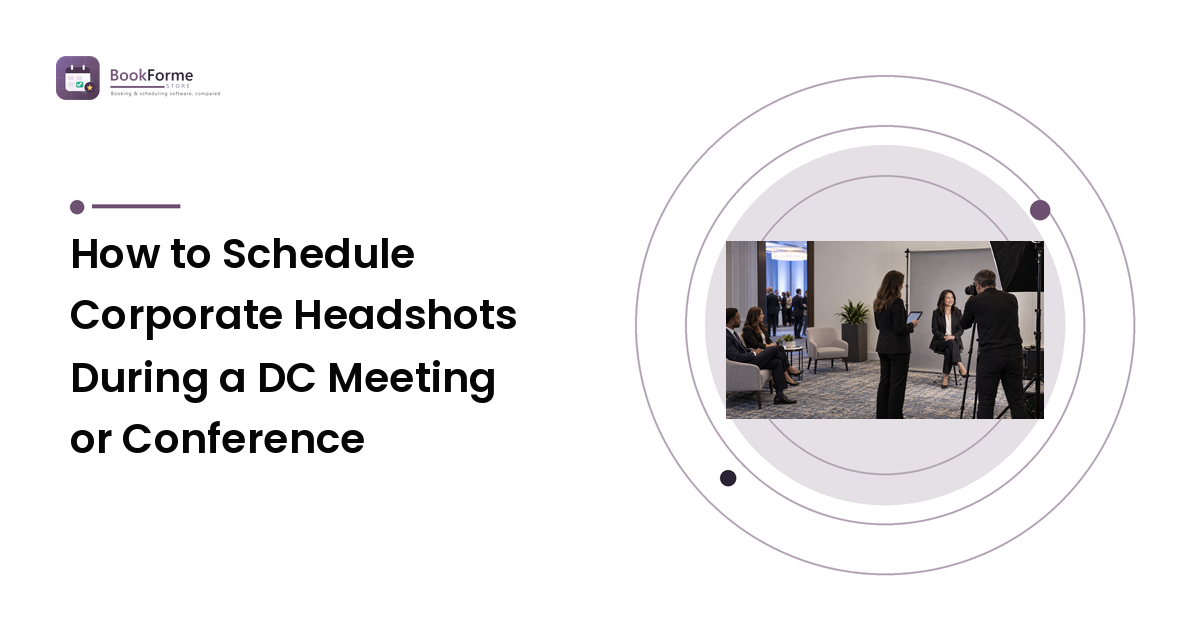
Adding professional headshots to a conference or company meeting sounds efficient: the team is already together, everyone is dressed for work, and one setup can serve many people. It becomes inefficient when participants arrive in waves, sessions run late, names are recorded incorrectly, or the event photographer has to abandon a keynote to operate the portrait station.
The fix is to treat each headshot as a short appointment inside the larger event. Define capacity, publish real slots, build buffers, capture identification during booking, and separate portrait time from documentary coverage. A calm schedule gives each participant enough attention while protecting the meeting agenda.
Give DC professional headshot photography its own block
Start by choosing when headshots can happen without competing with the event's most important sessions. Good windows may include registration, planned breaks, lunch transitions, or a dedicated team block. Poor windows include keynote openings, required workshops, and the few minutes before transportation departs.
Decide whether headshots are optional or required. Optional sessions need visible invitations and easy booking. Required sessions need assigned times and manager support. In both cases, publish the location and expected duration clearly.
When one team needs both event coverage and portraits, discuss staffing during booking. Event Photojournalism offers professional headshots alongside conference, convention, symposium, corporate-event, gala, and award coverage in Washington, DC and Northern Virginia. That combined service is useful when the schedule explicitly shows whether one photographer can move between responsibilities or whether simultaneous coverage calls for an additional photographer.
Calculate capacity before opening appointments
Do not begin with the number of attendees. Begin with the usable operating window.
For example, a two-hour block contains 120 minutes, but not all of them are portrait slots. Reserve time for setup, a short test, transitions, and recovery from small delays. Then divide the remaining minutes by the realistic time per person agreed with the photographer.
The slot must cover more than shutter clicks:
- Confirming the participant's name.
- Brief posture and expression guidance.
- A small number of useful variations.
- Transitioning the next person into position.
- Recording any approved selection or delivery note.
Ask the photographer for a realistic pace based on the desired output. A quick badge-style portrait and a more varied executive headshot are different appointments.
Use appointment windows instead of one long queue
A walk-up line creates uncertainty and pulls people away from sessions. Use short appointment windows with limited capacity. Participants can choose or receive a time, then return to the event.
A practical booking form asks for:
- Full name as it should appear in the delivery record.
- Work email or approved delivery contact.
- Team, organization, or attendee type.
- Selected time window.
- Accessibility or scheduling need.
- Consent acknowledgment appropriate to the organization.
Do not collect unnecessary personal data. The booking system exists to coordinate the session and match photographs correctly, not to build an unrelated marketing list.
Our broader scheduling guide uses the same principle: availability rules and buffers should reflect the service being delivered, not an idealized calendar with no transitions.
Coordinate DC meeting photography and headshots
Meeting documentation follows action: speakers, discussions, workshops, decisions, and interaction. Headshot photography uses a controlled station and repeated process. One person cannot be fully attentive to both at the same moment.
Mark these items on one shared schedule:
| Time | Main event | Headshot station | Coverage decision |
|---|---|---|---|
| Registration | Arrival and greetings | Open | Portraits plus light arrival coverage if staffing allows |
| Opening session | Leadership remarks | Closed | Protect documentary coverage |
| Morning break | Networking | Open | Decide whether networking or portraits has priority |
| Keynote | Main speaker | Closed | Photographer stays in session |
| Lunch transition | Informal movement | Open | Strong portrait window with buffer |
| Awards | Fixed milestone | Closed | Protect event coverage |
If continuous DC meeting photography matters, use separate photographers or keep the portrait station closed during important agenda blocks. Make this decision before attendees receive appointments.
Design the station for steady movement
Place the headshot station close enough to find but far enough from session doors, catering traffic, and networking noise. Confirm:
- Adequate physical space for the agreed background and lighting.
- Reliable electrical access where needed.
- A waiting area that does not block circulation.
- A mirror or simple final-check area away from the shooting position.
- Clear but discreet directional signs.
- A staff contact who can solve access or room issues.
Allow setup time before the first appointment. The first participant should not also be the lighting test unless that expectation is explicit.
Send reminders that reduce interruption
Use two simple reminders: one before the event and one shortly before the booked window. Include the time, location, expected duration, and what happens if the person is delayed.
Keep appearance guidance modest. Suggest arriving as they want to be represented professionally and bringing any quick adjustments they personally need. Do not impose rigid clothing rules unless the organization has a legitimate brand or uniform requirement.
Adapt the appointment reminder patterns to event language. The goal is not pressure; it is reducing confusion while participants are focused on the conference.
Create a fair late and walk-up policy
Some sessions will run long and some attendees will miss their time. Decide in advance:
- How long a slot is held.
- Whether late participants join the next available opening.
- How walk-ups are added without displacing booked participants.
- Who can authorize schedule exceptions.
- When the station must close so the photographer can cover another event segment.
Use a small buffer every few appointments instead of booking every minute. Buffers absorb normal variation and protect the final participants from a delay that compounds all day.
Match files accurately after the event
The scheduling record should make delivery easier. Use a consistent method to connect participant names with image identifiers, then review access rules before distribution.
Decide whether individuals receive private links, whether the company receives all approved images, and who may use them on websites, directories, press materials, or advertising. Put the agreed usage in the photography contract rather than improvising it afterward.
DC corporate headshots may contain personal information and employee likenesses. Limit access to the people who need it, use controlled delivery, and follow the organization's retention and consent requirements.
Frequently asked questions
How long should a corporate headshot appointment be?
It depends on the desired variety and review process. Ask the photographer for a realistic pace, then include transition time and regular buffers when calculating capacity.
Should headshots be walk-in or appointment-only?
Appointments create predictable capacity and reduce missed sessions. A limited walk-up list can fill cancellations without turning the station into a long queue.
Can the event photographer cover sessions and headshots at once?
Only when the schedule does not overlap or the team includes enough photographers. Protect keynotes, awards, and other unrepeatable moments from competing portrait appointments.
Is it safe to send one gallery to the whole company?
That depends on consent, organizational policy, and the delivery agreement. Private individual galleries or controlled company access may be more appropriate than a public shared link.
An event headshot station works when booking, capacity, and coverage priorities agree. Teams planning DC corporate headshots can review Event Photojournalism for professional portraits and event coverage, then build appointment windows that fit the real Washington, DC meeting or conference agenda.